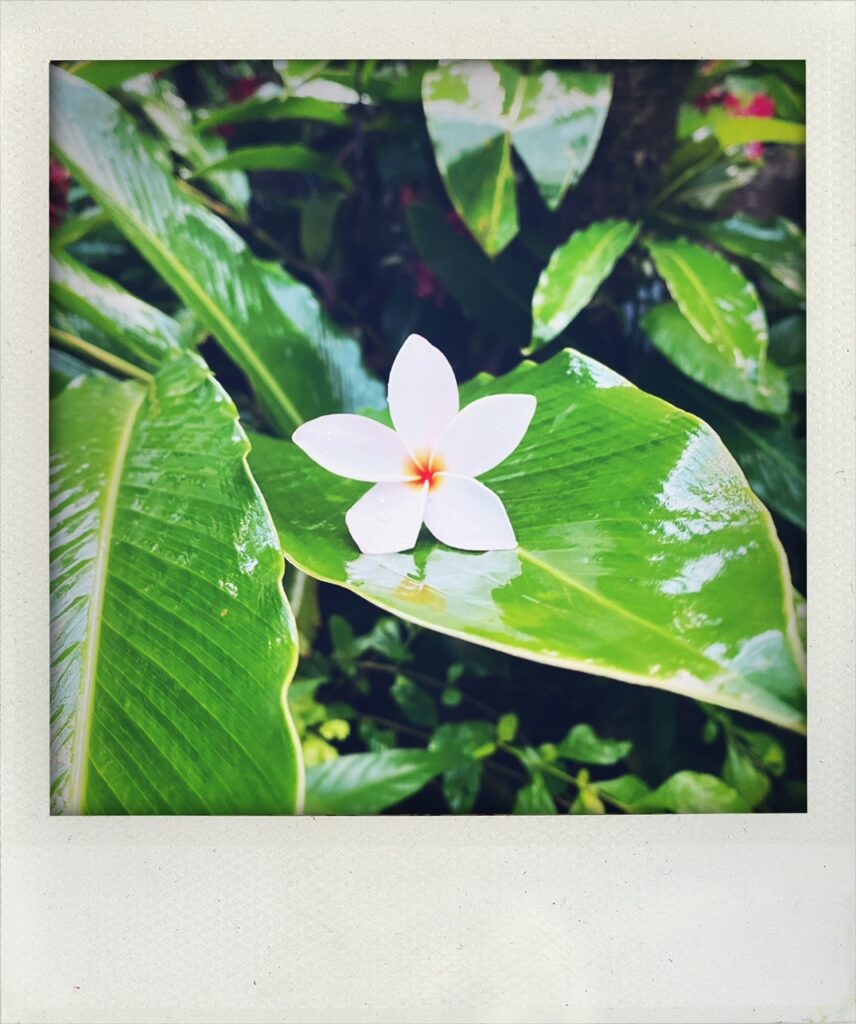
The mild dawn air is thick with moisture yet it easily carries the deep throaty calls of the howler monkeys, roosters of the jungle. Birds chime in here and there, but I don’t see any I recognize. I do see many houseplants I know, though—bromeliads, snake plants, bamboo, corn plants, spider plants—but here they are as tall as people and wild. I catch the sweet scent of gardenia, and I feel chosen when I find a fallen blossom, creamy and star-shaped, soft as baby skin. The tropical jungle is a juicy technicolor world, full of sound, everything my home in the Southern Rocky Mountains are not. In Colorado right now, the last of the autumn leaves are falling and the air is crisp. Bare branches and covered legs mark the end of fall colors and the start, we hope, of snowfall.
Here in Costa Rica, though, my skin glows, and the permanent cracks in my heels have disappeared. We are at the end of the rainy season, and within 10 degrees of the equator, the amount of daylight and the temperature seem to never change. I am on the Pacific Ocean side on the Nicoya Peninsula for a yoga retreat, and I am tuned to practice and listen: to the jungle, to the ocean, to my body and to the other people who have gathered here. Some are from Colorado and students of my yoga teacher, but others are from Switzerland, New York, Philadelphia, Washington D.C. and the Midwest. And everyone has a story. I sit down for breakfast across from one of my classmates.
“Are you the one who is from Switzerland?” I ask a woman with straight brown hair, kind dark eyes and a cinematic smile.
“No,’ she says. “I am from the Midwest.”
“Oh! I’m from Illinois,” I say, always happy to meet a fellow flatlander. “How did you hear about this retreat?”
“Well,” she shares, “I was at a wedding and some friends of mine were about to go on a yoga retreat at this resort, and it sounded so amazing. Just what I needed. So I tried to book into that one but it was full. This one had an opening, so I just took it. Everyone said I was insane to go to a retreat where I didn’t know anyone, but that’s me!”
I am instantly fascinated by someone who would sign up to spend a week in a foreign country with a yoga instructor and students they have never met. I aspire to be that brave.
She continues.
“I have been working through some physical stuff. I hurt my shoulder at work and have been recovering from that.” she says. “And other things.”
She takes a bite of breakfast, and after a deep breath, says, “I was a COVID nurse, and it almost destroyed me and my body. It was just so hard where I was, where I had people telling me that COVID wasn’t real. Just day after day facing that kind of wore me down, and it showed up in my body. I had such shoulder pain, maybe it was my body telling me I had to stop. But I couldn’t. My parents watched me get worse and asked me why I didn’t quit, and I would always say, ‘If not me, then who?’
“Finally I had to make a change because I was in so much pain. So I quit nursing and went into medical sales. I started doing EMDR therapy to deal with the trauma and yoga to help heal my body.”
Experience with trauma, I find, is not unusual among those attending my yoga retreat, but that could be because it is not uncommon among people. Though PTSD (post-traumatic stress disorder) emerged as a diagnosis only about 40 years ago, the editors at the History Channel report that trauma is described in the oldest written piece of literature (The Epic of Gilgamesh, 2,100 B.C.) when Gilgamesh describes nightmares he has after witnessing his friend’s death. Despite being an endemic part of being human, trauma has not historically been talked about, at least not openly. Growing up, I knew that bad things happened to many people around me, but the prevailing prescription I saw in that place and time was to tough it out, to bury IT and move on. Words like “therapy” and “self-help” and even “yoga” were very fringe in the Midwest of the 1970s and 80s.
Since the dawn of the Internet and the new century, though, there has been an explosion of sharing, and it seems that once one person talks openly about something difficult, it becomes easier for others. A few decades of that cascade, and it now appears that deep pain is commonly held, whether from acute events–like abuse, assault or grief–or more relentless environmental stresses, like living in violent or unsafe situations, being bullied at school, fighting in a war, fearing ostracization or caring for sick people day after day who do not believe the disease that is killing them is real. I am overwhelmed with sadness.
Pain is a natural part of life, possibly all life, and human bodies have a natural healing cycle for trauma. If that cycle isn’t completed, though, the pain can embed inside a person like a chip that, when activated by triggers, reacts physically and psychologically, leaving the person stuck in a kind of a trauma trap that we now call post-traumatic stress disorder.
To battle PTSD, my nurse friend practices EMDR therapy (Eye Movement Desensitization and Reprocessing), a method developed in the 1980s to treat PTSD. In EMDR, therapists use techniques to desensitize painful memories and help patients complete the body’s natural trauma healing process. Research indicates that without treatment, unprocessed trauma can stay locked in the body for years, even a lifetime.
In between classes, I encounter another young woman, another Midwesterner, with bright green eyes and sunset hair who taught for a time at an inner city Denver school located in the heart of gang culture. She tells me there are four main gangs in that neighborhood, but her school serves as a safe, gang-free zone.
“It has to,” she says, “in order to function. In the fall they recruit the kids for gangs,” she says, and I can’t help but think of sorority and fraternity rush in college. “But when the kids are in school, there are no gangs—it’s a neutral place. They have to work in class with kids who are in other gangs, and they know that is how it is. I have seen kids from rival gangs work together to complete a project at school without any problems. Once school is out, though, the truce ends. It’s kind of an unbelievable thing to see.”
While she taught there, she saw that the kids live in a culture of violence, and she tells me there are fights. Often.
“Our school went into lockdown like twice a week,” she says. “Kids will come to class bloody and cut up. But at our school they aren’t prosecuted for crimes; we have no expulsions or suspensions. We practice restorative justice.”
I am unfamiliar with restorative justice, so she explains.
“Instead of using the traditional justice system of punishment, we get the two people involved together and work through it.”
At first, she says, school staff members meet separately with each person involved, but eventually the victim and offender meet together. Families and communities are involved, too, because an essential part of the restorative justice model is that juveniles need to be supported by and accountable to other people in their community. Results are measured not by the punishment to the offender, but by the repair—for victim and offender—done through the process. I ask if the community members are engaged or reluctant participants.
“They are pretty into this model,” she says. “These are working class people, but parents will take their 15-minute breaks from work and come to these sessions. It’s that important to them.”
My head is reeling from the poetic beauty of this model, how it makes me rethink justice from a punishment paradigm to one of repair; how it considers the impact of conflict on both the victim and the offender with the goal of disrupting a cycle. Instantly, I am thrown back to a memory from second grade. I was at the grocery store with my mom and I wanted a pack of M&Ms. She said no, and so I took them and ran ahead to the car. I was eating the candy when she got there.
“Where did you get that?” She asked.
“From the store,” I said.
“Did you pay for that?”
I didn’t reply but she and I both knew the answer, and within minutes I was in the store telling the clerk what I had done. We didn’t name it at the time, but it was restorative justice. Facing the person I offended and admitting to what I had done forced a reckoning inside of me. That the accounting swiftly followed my offense gave me no time to rationalize or project my anger, which could have diluted that moment of self-awareness. I didn’t walk away angry at my mom or the store clerk. I knew taking the candy bar was wrong. I left that store never wanting to go through facing a crime again but also feeling closure: owning up to my transgression and accepting the store manager’s request for an apology and payment (which I did) made us square. I could move on feeling wiser but not guilt ridden.
Growing up where I did, crime wasn’t normalized for me like it is for some, like the students at that Denver school. I try to imagine myself as a kid who lives where crime, violence and fear swirl around them. Does reckoning complete the trauma cycle for them? Won’t it just begin again the next day? But the measure of success used in restorative justice isn’t whether damage ends, but if repair has begun, with the hope that more repairs will lead to less future damages.
Though psychological help is more available than ever, most trauma victims who live with PTSD symptoms are largely left to heal on their own. There is no protocol treatment like we have for broken legs and torn ligaments. If resources are available to you and you can afford it, many people have benefited from therapy; EMDR as well as Cognitive Behavioral Therapy, or CBT. Statistics show that even though 7 in 10 Americans experience trauma, only 2 of those receive therapy (and therapy is not always successful). That leaves a lot of wounded souls out there. Looking around the yoga retreat, I feel a surge of hope thinking about the people who have bravely shared their stories with me, both of their pain and their recovery. It inspires me that, in coming here to this warm place to practice yoga and meditation, they are choosing to heal.
Looking out over the thick multi-storied jungle plants, with vines winding like safety nets and leaves so large I could lay on them, I hear the roar of trucks and pounding of hammers in the background as trees are felled and the jungle cleared to make room for another home. This close to the beach, most of the new houses are garishly large and tall, surely designed to capture the ocean view from above the trees. Even in this blissfully natural place, the human touch is everywhere, and it is not always light. I see that the recipients of trauma are not just people.
The beach I speak of is in one of the world’s five “Blue Zones,” places whose residents live the longest and happiest lives. It was not always so, though. Costa Rica, I learn over breakfast one morning, was not invaded by the Mayans or Aztecs of Mesoamerica or the Incas from the south. However, they speak Spanish here, and despite resisting invasion for centuries, Costa Ricans, like Native Americans, also suffered from Christopher Columbus, who landed on the east coast in 1502, during his last trip. Costa Rica was colonized by Spain shortly after in 1561 and remained under Spanish rule for roughly the next 300 years until it achieved full independence in 1821. The country enjoyed a relatively peaceful period after that until the 44-day-long Costa Rican Civil War in 1948. Called the bloodiest event in Costa Rican history, it was ignited when the ruling president, who was not re-elected, tried to hold onto power and overturn the election results, citing fraud. The rebels, led by the authentically elected new president, defeated them. This led to a new constitution that, among other things, dissolved the military.
I find it interesting that Costa Ricans’ response to corruption in their government was to disband their military, essentially arming no one. How that contrasts with our own answer to our nation’s rebellious birth, which was to arm everyone. Liberated from the expense of an army, the Costa Rican government redirected that money to health, education, and a guaranteed pension for seniors. Though a poor country compared to the United States, Costa Ricans, with an average life expectancy of 80.75 years, are generally healthier than the 77.28 years for Americans. Most news articles on Blue Zones find similar themes: emphasis on medical care, healthy diet, strong community, close family ties and a safety net that covers your basic needs in life. In essence, I guess, the Costa Ricans chose healing over fighting.
Driving to the airport after the retreat, I scan the countryside to get a feel for this intriguing place. I see mostly small, single-story stucco homes. “Tico houses,” (Ticos is what Costa Ricans call themselves), have small yards, some have laundry hanging that will probably never dry. Some have small gardens, while others have a cow in the backyard. We pass many fields, some with crops, others with small herds of skinny cows. About a third of the way to the airport, the van stops unexpectedly, and a robust older man comes out of the small house to hand our driver a paper bag and a clean shirt that says Nosara Fishing on it, ready for him to go to his second job. It is the driver’s parents’ house, and I am touched by the moment of caring and support.
Looking out the van window at the last pastel hues of Tico houses sprouting like flowers among palm trees and power lines, I wonder if healing trauma is our own work or the job of a system that makes healing a priority. Costa Rica has charted its own path by choosing health over violence and then creating a system that supports its people, who support each other. Maybe it takes both to really get to a Blue Zone.