As I gaze out the passenger window, chauffeured by my 15-year-old, I admire the deep cabernet of this year’s autumn oak leaves, which are fading to amber and rust in some places. Some aspen gold lingers on the hillside, but it is late fall, and the oaks are stealing the show right now. I am pulled out of my reverie by my driver’s sudden announcement.
“We need to talk,” she says, and I can see the troops rallying in the battleground of her mind. “I start work tomorrow, and I’m nervous about it.”
Her laser eyes and thin lip line tell me that she is both ready to fight and resigned to the outcome. This makes my part of the conversation tricky because it will be easy to say the wrong thing; maybe, even, there is no right thing. But she is seeking my counsel, the older and wiser human, the parent. I long to return to taking in the last fall colors, but I surrender to my role.
“What is making you the most nervous?” I ask.
“That they won’t like me,” she says.
“Why do you think that?” I counter, nervously aware that the wrong words will send her packing from the conversation.
“Well, because I don’t really want to be there, so I won’t be talking, and they will think I am mad or mean or whatever and they won’t like me,” she says, brow creasing.
“If you don’t talk much try to remember to smile more, then they will just think that you are shy,” I say. “I mean, these are just stories you are telling yourself about how it’s going to go. Can you just as easily tell yourself it is going to go well?” I ask.
She ponders.
“Yeah, I think it’s just easier to think the worst.”
We sit in quiet for a minute, and I notice how the recent snowfall on the peaks contrasts with the burnt orange of the willows that line the creek. I drink in the color, aware that the landscape is marching through monochrome toward winter.
“It’s like my guy Nietzsche and his idea of an Übermensch,” she offers.
Intrigued, I invite her to share.
“Übermensch means an overman,” she says. “It was his idea of what humanity should strive for. People think he is a nihilist, but really he just wanted people to move away from the Christian morality. The Übermensch is a model to strive for. I think that’s what being happy is, just being your best self.”
I am dizzy trying to follow her thought labyrinth from, “things are going to be really horrible,” to discovering her own Übermensch. It seems an uneasy weld between the height of hope and depth of despair. What binding energy holds these together?
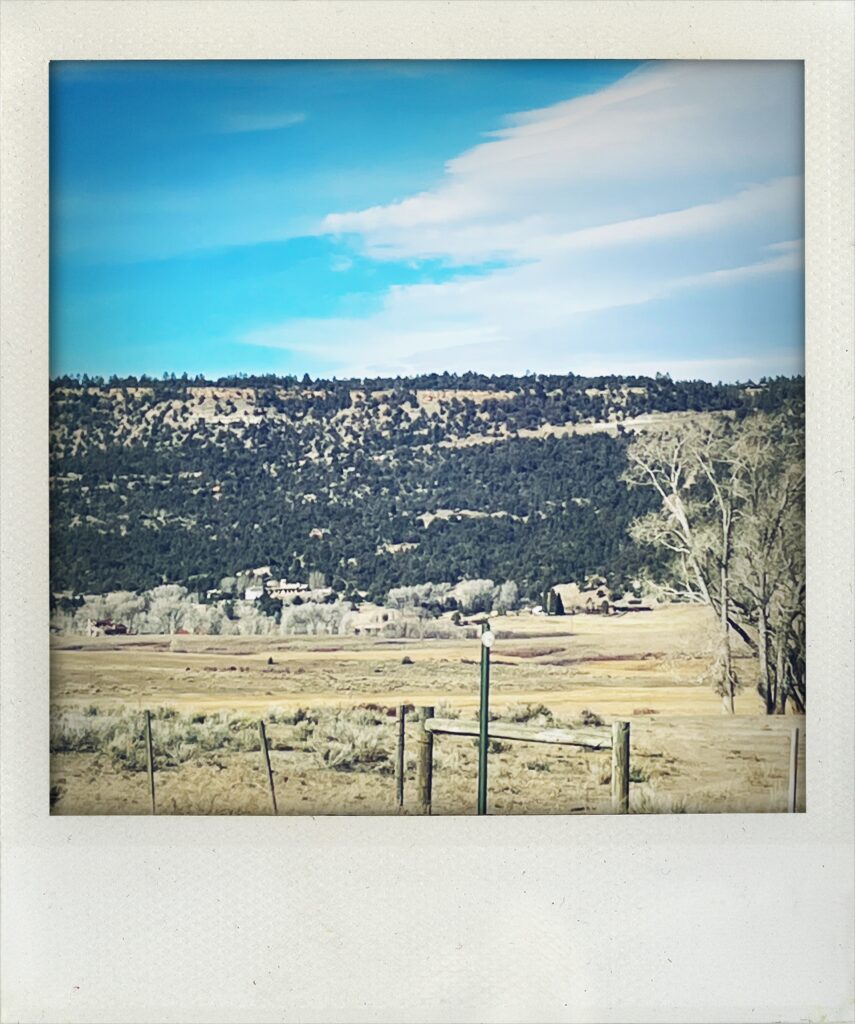
I look to the brown barren fields for help, the ones that lie between the thick trees of the national forest and the ranch homes lining the highway. I wonder if that’s the key, those open brown spaces. Being your best self speaks to your internal self that you can manage, your ranch house. But what about the outside world? There is no control there. For her, the anxious and unpredictable begins right outside her bedroom door. Literally. Once she leaves it is Where the Wild Things Are, but she is no Max. She has no magic trick that will make her king. Instead, she is like a coatless schoolkid unprotected from the weather. Then, it clicks! She has no defensible space. I bring this to her attention.
“There isn’t much you can control about other people,” I say. “But I think you can do a lot to create a defensible space, a kind of shield between you and and how others affect you. Like the brown fields between the ranch houses and the national forest. Your defensible space is a buffer, or maybe think of it like a coat you can put on that protects you when you go outside.”
She stares at the road ahead. I mistake her silence for engagement, so I continue.
“You can create your own defensible space by managing your thoughts, picking your friends, your job, where and how you live. If you listen to your intuition and make choices that enrich your life, you can make a kind of safe zone, if you know what I mean.”
The annoyed look on her face says that she clearly doesn’t, and not only that, it looks like she really wants me to get back to the conversation she is trying to have about her anxiety of going to a new job.
I, however, am sure that I am giving her a useful life tool, so I dig in. I tell her how, in the 1970s, architect Oscar Newman introduced the idea of defensible spaces. He sought to reduce crime through building design because he believed that in low-density housing people felt more ownership. In high-density living, like high rises, people thought everyone else would take care of the problems. In the mountains where homes are next to wilderness, defensible space is a buffer created between houses and wilderness to stop, or at least reduce, damage to your home from natural disasters.
Creating defensible spaces, like these brown fields I see along the highway, means a clearing free of dead, dried and overgrown brush that is easily ignitable so that if a wildfire reaches those cleared fields, it will find less fuel and might protect your home. Urban or rural, the theories align in that there is an outside world beyond your control, an inside world that you can largely control, and an area between the two that you can impact to create a safe transition zone between the two.
I implement this in my life, I tell her, by my choices. I prefer quality friendships to quantity, a healthy work environment over the work I actually do, hobbies that enrich my life rather than fill time, and a home that is modest but near the mountain wilderness that sustains me. My defensible space gives me a safe space that helps me navigate intersections with things like toxic people, medical nightmares, economic downturns, political devastation, and the soul-sucking of social media. When everything gets me down, I have good people, satisfying work, soul-filling hobbies, loving relationships and wilderness to lift me up. And they always do.
As I finish my lecture, I am still looking out at the sloping land beneath the peaks, a mottle of muted gold, chocolate brown and forest green against the red canyon walls. I feel my defensible space call out, reassuring me that the raging wildfires of modern life will not claim me. I turn back to face my daughter, surprised by the look on her face that screams bottled rage.
“Oh honey,” I say. “Oh no. That didn’t help, did it?”
“Go on and on with some stupid out-there theory about something that is not related at all to what I am saying. Not helpful, mom.”