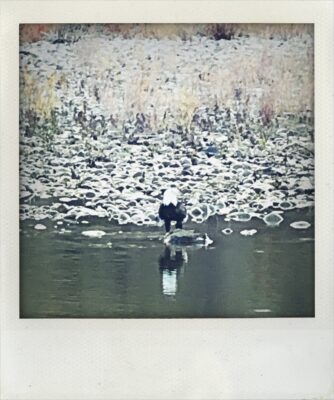
A lone bald eagle stands at the muddy edge of the cold winter Colorado River, white head gleaming against the brown bank as it reaches down into the river again and again feeding on something in the water. My daughter and I, too, stand at the river’s edge, our backs to the largest city on the Western Slope, named “Grand Junction” for its site at the collision of the Colorado and Gunnison Rivers just downstream of where we stand.
As the eagle and I consider each other–me more intently than the bird, though my presence is surely noted–I see that each of us is seeking sustenance. The eagle is securing physical provisions and I am seeking the soul rejuvenation I gain from nature, especially when I am in urban settings. This mighty Colorado River sustains more than the eagle and me. Countless wildlife, approximately 40 million people and almost 6 million acres of farmland from Colorado to California rely on its flow.
Today, though, as the clouds hover just above the horizon, it feels like an intimate place, a casual rest stop for the eagle and I to meet our needs. As I watch the bird eat, I imagine it has a simple existence of hunting and eating, flying and resting, mating and nesting. Though I believe my life to be much more complex, my need for wilderness is direct and unyielding: from it I get a connection that recharges me as surely as air fills a balloon. When I find myself drained and empty, I head straight to the nearest natural place. Today is such a day as my daughter and I– both exhausted and emotionally overwhelmed–watch the eagle while we frantically take photos.
We both stare fixedly at the eagle’s immersion in this solitary task. For different reasons, my daughter and I are both envious of the business-as-usual feeling we get from the bird. A senior in college, my daughter is in her hardest semester yet, and a family crisis that demanded her presence has cost her precious time and energy, pushing her into her own red zone of recovering her grades, upon which her scholarship depends. She is facing a backlog of work and hoping that whatever sheer effort she can muster will restore her academics to where they were a few short weeks ago. I want to break free from a whirlpool of emotional exhaustion and immerse myself in nature, wishing it was a magic spell that would refresh me and transport me back to an earlier time when I wasn’t so worried about my daughter and the growing burdens of her increasingly adult life. I think I may even see the first lines on her twenty-one-year old face.
Whereas the eagle seems nonplussed by our presence, we are on alert, moving about to try to get a better photo because it is rare to be this close to such a spectacular bird who is staying put. My daughter is a photographer with a better phone camera, so I stand and watch, and it is a cruel moment. Maybe it is the grey day or the specter of the holidays that always have a bittersweetness to them, but regardless of my hunger for it, I cannot find any space inside myself to take in the soul nourishment that is all around me. I am completely full of swirling emotions–anger, sadness, frustration, grief–with which the eagle clearly is not contending. All I want is some peace, and I resent the human condition so wrought with feelings that are rarely tranquil. What can possibly be the benefit of the wild and complex internal emotional storms that seem to rise of their own accord?
As we do when life delivers sudden and serious changes, I have been wrestling with my emotions for many months trying to work with them and learn from them instead of fighting with them. One source of wisdom for this has been Karla McLaren’s book, The Language of Emotions. She takes an exhaustive look at the topic, spilling out and examining the Crayola box of feelings, most of which are undesirable. Each emotion gets its own chapter, and out of eighteen, fifteen are lamentable: anger, apathy and boredom, shame, guilt, hatred, fear, anxiety and worry, confusion, jealousy, loneliness, envy, panic, sadness, grief, situational depression, and the suicidal urge. There are just three chapters on the things we all want to feel: happiness, joy and contentment.
McLaren argues, though, that there are no bad feelings. She says that emotions are messengers from a wise interior place that bring us gifts of information about how we are experiencing life and adjustments that we need to make. Though the book is a lengthy, detailed manual to teach the emotional language, McLaren advocates that we can all gain emotional fluency, and then it should be employed like any other conversation in your life–in a flow. She urges us to engage with whatever feeling comes up, listen to what it has to say, take the appropriate action and then move on, like we would when a timer tells us to take bread out of the oven. Some emotions, like some conversations, can be profound and life-changing, like grief from a sudden death of a loved one or trauma from an assault. Most feelings that percolate to our surface awareness, though, bring more transient messages, at least initially. If you don’t listen and respond, McLaren cautions, the messages will get stronger and your experience of them more challenging.
Watching the eagle, I realize it is naive to think the bird is an emotionless being because many animals experience feelings and remember reading that most animal behavior scientists believe that animals from primates to octopus and squid display emotion. About half even thought that fish and amphibians experienced emotions. With feelings everywhere in the animal kingdom, how is it we know so little about them and what they mean?
I am on friendly terms with my emotions, but I do find them perplexing, like abstract art. Am I crying because of what is happening now or a memory of something from months ago or from what I fear might happen in the future? Is crying a natural, healthy response you should allow, like a sneeze, or is it more like a nervous tic that you can reduce or eliminate with awareness? And why do we cry so much when we are small children and then so little as adults?
I would not want a life without feelings, but times like today I wish there was a volume adjuster that didn’t lead to rehab. McLaren doesn’t offer much advice on this, so first I seek a source for these feelings that are clutching my chest and clenching my gut; a splinter to dig out. I find too many reasons and realize identifying them offers no triage for this acute situation. I then try to breathe my nervous system into regulation, but I just get deep sobs for the effort. My feelings are so strong today that my tears threaten to fall like one too many packages held in my arms. I can’t discern what my emotions are asking of me, but I know there is little I can do about what my daughter is managing. I only can listen and support her so she is not alone as she navigates the sudden heartbreaking transformation of some of her most primary, long-lasting relationships.
I find that shifting my gaze from her to the eagle pulls me more into the day where I may find some peace, even for a few moments. As tears roll down my cheeks, I focus all my senses on a cooperative eagle and a young woman taking pictures. I take in the intention of her posture, leaning forward into photographer mode. I see the butter curl of the eagle’s beak as it reaches down into the water to pull up a bite, its gleaming ghost head swiveling to survey between bites, then diving down again with authority. My daughter crouches in the brush to get closer. The eagle’s shoulders raise slightly with each rising, military like. They are such commanding birds. A few times the eagle’s wings extend in readiness, then collapse as the bird returns to its dinner, until finally flying into a nearby leafless tree. I see my daughter’s face blossom into a smile as she jogs back toward me, “I got it,” and shows me a video of the eagle in flight. It’s breathtaking, and I feel joy enter the crowd of emotions inside me, somehow expanding the internal space.
I inhale the winter chill of an unfrozen river, taking in the absence of earth smell in the cool air. As my thoughts surrender to my senses, my throat relaxes and then my whole body. I try to hold the image and the serenity within it–just my daughter, the eagle, the river and I–but my contentment, like the river, flows right on by as the moment becomes memory.