“Only to the extent that we expose ourselves over and over to annihilation can that which is indestructible be found in us.”
–Pema Chödrön
It starts with a brief stroll, ten steps or so on gently sloping ground, before it matters. The descent–a hard-to-fathom 2,000 foot drop over one short mile–will equal about 375 flights of stairs except no two of your next 4,000 steps will be the same. One step will land on a lovely, solid rock that holds the weight of you and your pack like a mother. The next will hit a soft slope of July dry dirt that slides like cake flour. Yet another may land on what appears to be solid rock but is actually a dinner plate on a bed of empty clam shells. The steepness never yields, and even one misstep can mate with gravity to send you tumbling.
This is what the next two hours will give you: forced walking meditation. Every step is scouted, carefully chosen, often with three points of contact: foot, foot, pole, or sometimes even a hand added on whatever it can find that seems stable. Only one should lift at a time. Just when your mind starts to wander, as it does on any hike, from mundane thoughts of how much you love your new hiking shorts to lofty musings about permanence and transience inspired by gazing at rock that is more than a billion years old, you hit the dinner plate and in seconds you are sliding down fast on your ass, digging your heels in, stopping, and rejoicing that you are only scratched and bruised. This is where I sit at the moment.
“So there’s a trick,” my hiking partner offers as he hikes back up a few feet to check that I am okay. “You don’t think you have any time before you fall, but you do. You have a second, and in that second, push your hips out so you fall on your pack. It’s better. Trust me.”
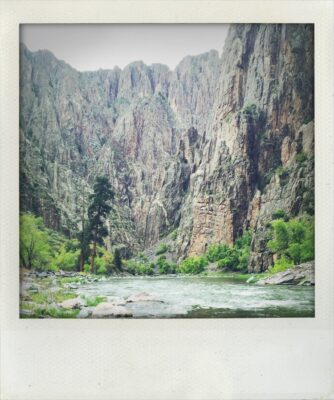
I do trust him because he has been down into the Black Canyon of the Gunnison– the oldest exposed rock and narrowest canyon in Colorado–dozens of times to every one of mine. It is a sacred and special place to him, a pilgrimage he takes at least a few times a year and has for decades. Sitting for a minute to gather myself, I think back to June of 2000, my first trip in. Back then just before the hike down, I thought, “Awesome–downhill!” It didn’t take long for me to decide that I would rather hike out of the Black Canyon ten times than hike down once.
There is a bluebird summer sky above me and recent rains have cut the heat, but I can’t look up. As a blossoming bruise recites the price of not paying attention, I resolve to stare at my feet and the trail until I am at the river’s edge.
Hours later I am at the bottom, and the world has devolved back to its origins. We are weeks past the stonefly hatch, the annual event that draws fishermen to these hard-to-access waters. An insect whose fossil record dates back to at least the Jurassic, the stonefly bears its prehistory in every regard. This species of Pteronarcys (yellow bird) is improbably large–growing up to two inches long–and flies slowly on a drunken, erratic path. You can reach out and grab them in mid-air if they fly in arm’s reach. For the trout that live in these cold waters, this is the grand buffet of the summer.
Though the stoneflies date back to the Jurassic, the gneiss walls of this canyon go back about 1.7 billion years, more than a third as old as the Earth itself. We are gazing at stone from the belly of our planet and a chasm of time opens. The world humans have made recedes and we quiet until we can hear the walls breathe, the walls whose rock is so hard the river can only carve an inch every century-six times more slowly than comparatively supplicant sandstone of the Grand Canyon. In fact, other than the trail we hike in–noticeably more traveled–the canyon itself in this very spot seems unchanged in more than 20 years. What is 20 years to these walls? Not even a blink, but to me it has been the heart of my life–marriage, children, deaths and births–the flotsam of life that gives distinction to its self-similar fractal parts. And yet this place, with its eternality, gives me so much comfort in how rock from deep inside this Earth has such strength that it can exist visibly unchanged.
I am not unchanged and show the life I have lived in my softer body, my opening heart, my released fears and attachments to the idea that there is any permanence in my little human life. Still these walls of ancient stone, and my mind’s failure to conceive of years in the billions, finds me reaching out, wanting to hold on to this now as if it could be a forever. I want there to be a truth, a beating heart at the center of it all that is eternal, immortal, immune to human failure. A core so solid that it is beyond our ability to destroy or, somehow worse, deform.
But I look to the river, frolicking over boulders and dancing through this hard, hard canyon to see the only truth there is. It’s all just flowing, changing by the minute, heartbreakingly impermanent to our capable yet wanting hands. I reach into the icy water, close my fist and come up with nothing. I look up at the steep canyon walls and that unrelenting sun as it hovers on the edge of the canyon wall, painting the grey walls a honeyed amber and I am caught and held. They say nothing gold can stay, but if you look, you can always find more gold.
🩶🩶🩶
Thank you friend! xo
An enjoyable commentary on traversing difficult terrain, recognizing it for what it is and represents, paying attention, and being satisfied with how infinitely inconsequential we are in the grander scheme of things.
Thanks for those powerful thoughts Tim. I am so happy you found all that in there.