Choose Your Hard
Marriage is hard. Divorce is hard.
Choose your hard.
Obesity is hard. Being fit is hard.
Choose your hard.
Being in debt is hard. Being financially disciplined is hard.
Choose your hard.
Communication is hard. Not communicating is hard.
Choose your hard.
Life will never be easy. It will always be hard.
But we can choose our hard.
Pick wisely.
– Devon Brough
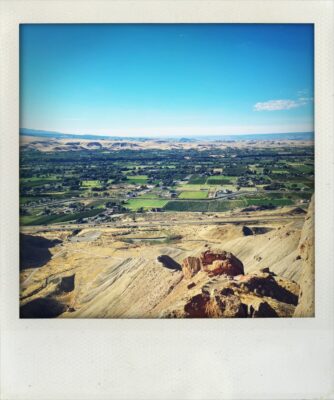
As my feet hit the hard golden dirt of the desert trail, I relish that it’s one of those mornings that I want to capture in a bottle—jacket cool but the radiant sun in the cloudless sky promises that I won’t need sleeves for long. I am starting my hike at an elevation of 4,700 feet just across the road from the part of the Grand Valley where grapes and peaches grow in a southern California-like microclimate. I look over at the orderly orchards, their peach trees lined up like late summer holiday trees with honey orange ornaments.
These fruit trees are nurtured by fertile valley soil and a ready supply of Colorado River water that winds through the orchards, but it is also the extra warmth that is released by the heat-holding natural rock formations bordering the valley that helps fruit to thrive. Saving it from frost is a phenomenon locals call the Million Dollar Breeze: wind that funnels down the DeBeque Canyon and through the fields, providing just enough moving air to keep frost from settling during those scary nights when temps drop while blossoms or fruit are tender on the trees.
In just two miles, I will finish my hike at 6,765 elevation on the top of Mt. Garfield, a glacial horn that marks the highest point of the Book Cliffs. The hike is flat and easy for only about 50 feet when it turns and heads straight up one of the finger hills splayed out at the base of the Book Cliffs. If you are doing the math, I will gain about 1,000 feet of elevation per mile. I don’t expect the trail to get so steep so quickly, but in minutes I go from yawning to breathing heavily as I work to huff it uphill. Legs and heart pumping, soon I feel tears coming up as I think of the other hard thing going on in my life right now: fighting with my partner.
Though we couldn’t seem to agree on anything this week, I am not ruminating over a specific argument, but rather the non-productive way we argue, and it can be about almost anything. You might even be familiar with this kind of ride. It starts with a request that is really a complaint with a question mark at the end of it, something like this: Can you please clean your pan when you finish using it so it’s ready for the next person? You know, the one that’s been on top of the stove for two days now.
From here it quickly pivots away from dirty skillets to talk of my tone or my timing in bringing it up or that it’s always something–all atmospheric elements that have nothing to do with the actual issue–the dirty pan that was ignored. How we discuss discordant topics seems to become what we always talk about, leaving the issue that prompted the conversation unresolved and both of us exhausted. We don’t even know how this happens. We start on a trail that is clearly leading somewhere and then we find ourselves wandering around the forest, blaming each other for being lost. Neither of us is able to find a way out and we both end up tired and beat up until silence erases the forest and a little more of our relationship.
Today, hiking only up, I am hurt and discouraged because if there is one thing partnership promises it is that there will always be another disagreement, and my partner and I seem to be no good at resolving them. Just like there is no easier way up this horn, conflict is always difficult, but can it be productive?
Across my nation, relationships have been pushed to the brink and beyond by disputes and lack of options for handling them. Instead of moving forward, family and friends get stuck in opposition and become, if not enemies, much less friendly. I have seen the promise that productive discord is possible in books that teach us to “Fight Right,” or podcasts offering instructions on “The Science of Disagreeing Well,” in which a 45-year long mixed marriage–a democrat and a republican–who are polar political opposites are presented like the endangered role models they are. How do they do it? We are left marveling.
Boundaries, the couple says, are key. There are some topics the Right-Left spouses do not talk about because they don’t agree. This is where you end and I begin, they show us. And we cannot be a unit unless one person has surrendered their individuality. I think that most people know they are a separate person from everyone else they meet, so I am not sure that is the heart of the issue. That’s where science comes in.
Using sci-fi swim caps, Yale neuroscience professor Joy Hirsch looked at the brain activity in real time of people when they were talking and in agreement compared with when they disagreed. When the people were aligned, their brain activity looked similar, like walking in step with someone. When the two opposed, however, the brain activity became asynchronous, a cacophony, and the brain consumed far more neural energy, both in the emotional and cognitive spheres–like a three-legged race instead of a side-by-side walk. Division is very taxing on the brain. If it escalates, the brain may see it as trauma, and then it can trigger one of the body’s natural stress responses of fight, flight, freeze or fawn (which is perpetual acquiescence).
When trauma responses are triggered, the door is closed for resolution. The body has taken charge of the situation, which suggests that there is a narrow territory in which contention can happen respectfully before it turns unproductive, and even harmful. Some might claim there is no productive conflict territory at all, at least not without agreeing beforehand to some ground rules and boundaries. Before all of that, though, we ask, “what are we trying to accomplish anyway?” The word “agree” has its origins in pleasing, while division is collision, fighting. Is it even possible to have an agreeable fight?
I am in a particularly steep section of the trail where the switchbacks are stacked when my rapid pulse asks for a rest. I resist stopping as my eyes see what my circulatory system cannot–a section just ahead that levels off where I will catch my breath and get some water. Below me are broad stunning views of the Grand Valley, a contradictory landscape itself where barren cinnamon and brown sugar rock formations border a river of green fertility; where dust and sand swirl above grape-loving alkaline soil enriched from eons of alluvial deposits. It is an essay in complete opposites, but their coexistence is something we celebrate in the Southwest because it yields a bounty of nourishment.
I inhale the still cool air as my breathing slows and I return to the fight at hand–pushing myself up again and again, my heart pounding with a pure purpose that helps my hurt feelings course through my body instead of whirlpooling in my mind. Though I am still thinking about the most recent futile quarrel, I am only fighting gravity today, a battle I can never win, but I will gain the day when I reach the spot where there is no more up.
It will take hours, but that is what I am after–a release from mentally reviewing the pointless past of bickering that replays but never resolves. Not too far from the top, when I have slowed to a one-breath, I finally feel the shift. I have fully re-entered my body. My mind has left the driver’s seat and moved over. A sense of relief fills the car as we gain perspective and acceptance. I have been hiking switchbacks straight uphill under the September sun for two hours and it has been salt-sweaty work. But this is my kind of hard–the kind where, with effort, I get somewhere new and I feel stronger when I arrive, even if it is just to turn around and return to where I started.
Wonderful essay on conflict with the metaphor of a mountain trek. Even added a new F in Fawn to the string of Fight Flight Freeze — so right! And the descriptions are lively and vibrant. Great one!
Thanks Art! I really appreciate you.
Sometimes the only thing we can agree on is that we disagree. Thinking of you my friend and sending out healing vibrations. Choose your hard. 🩷
Thank you for the kindness and healing energy. That means so much to me. Friends like you make the hard easier.
Your way with words and working through things always impresses me, friend… “my heart pounding with a pure purpose that helps my hurt feelings course through my body instead of whirlpooling in my mind.”
Thank you for that! I am so happy you liked it. xo